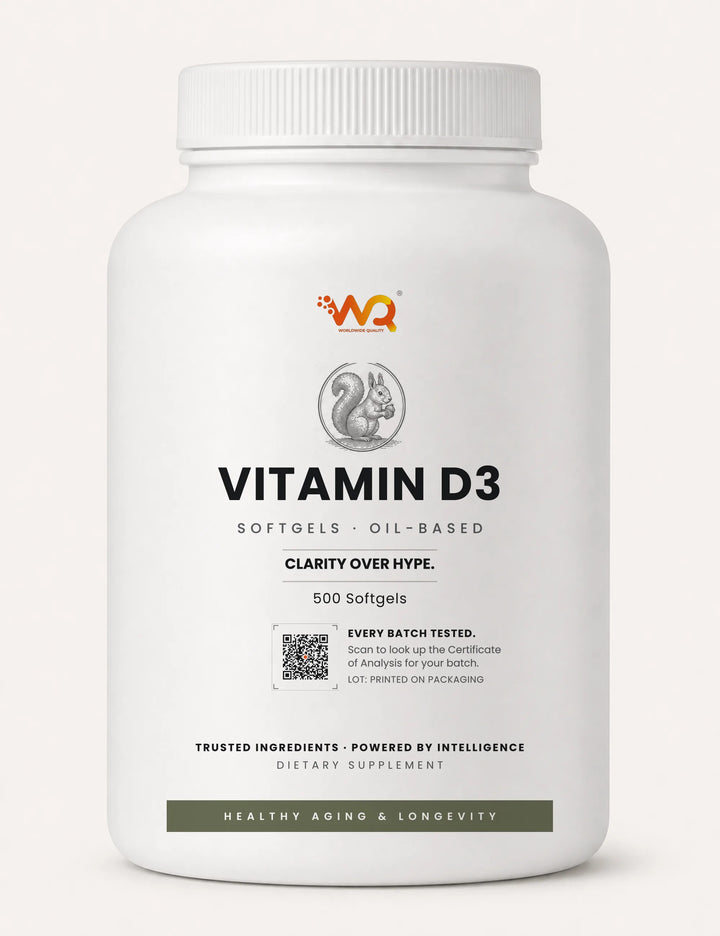
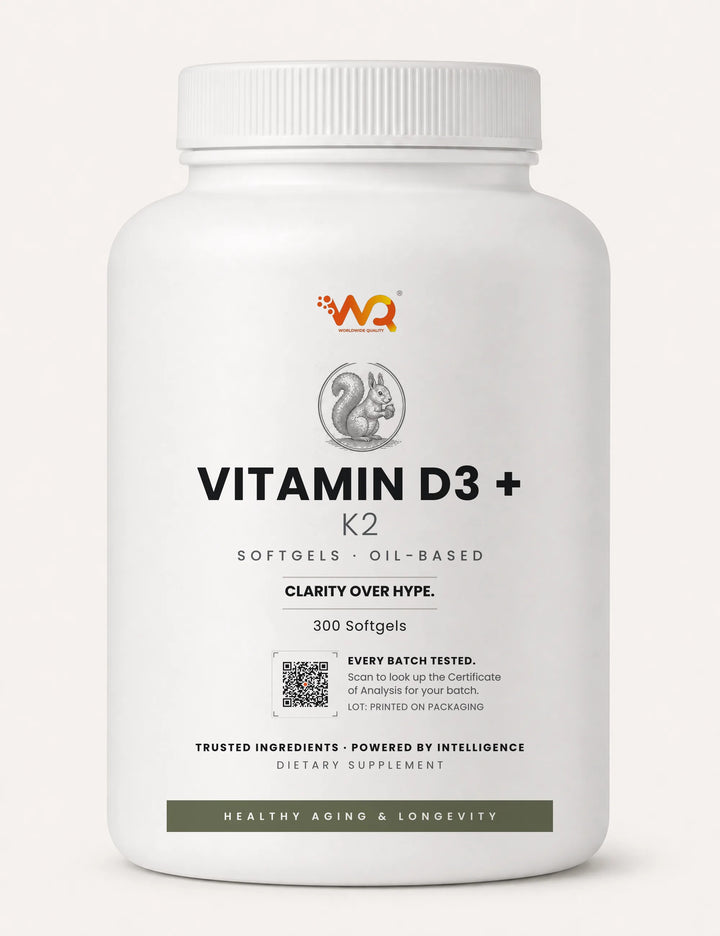
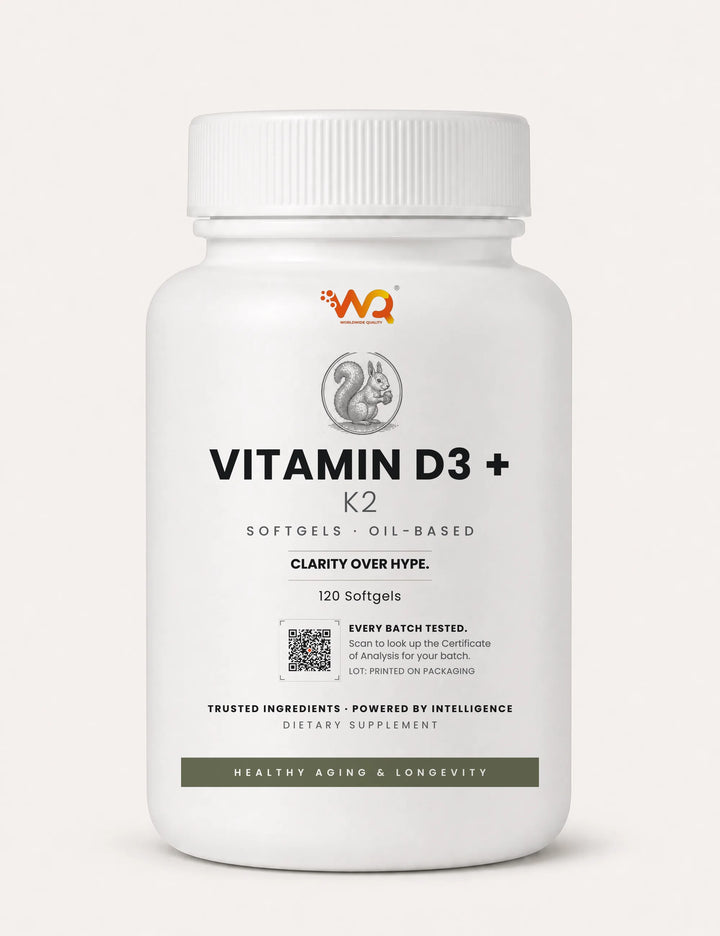
Vitamin D3 dominates the supplement shelf for a defensible reason: a substantial body of comparative research shows it raises and sustains blood vitamin D levels more effectively than vitamin D2, even though both forms are technically "vitamin D" on a label.
Two Molecules, One Name
Vitamin D2 (ergocalciferol) is derived from plant and fungal sources, while vitamin D3 (cholecalciferol) is synthesized in human skin from UVB exposure and is also the form found in animal-derived supplement sources like lanolin and fish oil. Despite both metabolizing into active vitamin D compounds, they are not biologically interchangeable at equivalent doses, and the research comparing them has grown substantial over the past two decades.
The Head-to-Head Evidence
A landmark 2011 randomized single-blind trial published in the Journal of Clinical Endocrinology & Metabolism dosed 33 healthy adults with 50,000 IU per week of either D2 or D3 for 12 weeks and found D3 was approximately 87% more potent at raising and maintaining serum 25-hydroxyvitamin D concentrations, producing two- to three-fold greater storage in body fat than equimolar D2 . The same trial found D3 storage in subcutaneous fat rose by 104 μg/kg versus just 33 μg/kg total calciferol for D2, and the researchers concluded that D3 was the more potent option in the protocol studied .
A 2012 meta-analysis in the American Journal of Clinical Nutrition pooling multiple randomized controlled trials reached a consistent conclusion: D3 supplementation had a significantly greater effect on raising serum 25(OH)D than D2 (p = 0.001), with the advantage most pronounced when D3 was given as a single bolus dose rather than daily dosing, where the gap narrowed . A more recent 2024 systematic review and dose-response meta-analysis in Advances in Nutrition, incorporating 20 comparative studies, found D3 produced a weighted mean difference in total 25(OH)D that was 40% higher than D2 in daily-dosing comparisons analyzed via mass spectrometry, though the researchers noted body mass index was the strongest modifier of this response — the difference lost statistical significance in participants with a BMI above 25 kg/m² .
Where the Evidence Is More Mixed
Not every study agrees that D3 is meaningfully superior at every dose and timeframe. A 2008 randomized, placebo-controlled trial in the Journal of Clinical Endocrinology & Metabolism found that a 1,000 IU daily dose of D2 was just as effective as 1,000 IU of D3 in maintaining serum 25-hydroxyvitamin D over 11 weeks, and D2 did not negatively influence D3 levels when combined . A separate 2015 pharmacokinetic study similarly found D2 and D3 were equally effective at raising 25(OH)D levels immediately following a loading dose, though D3 proved more effective at sustaining those levels over a longer follow-up period, with an elimination half-life of 111 days for D3 versus 84 days for D2 .
The pattern across these studies suggests D3's advantage is less about short-term peak effect and more about durability — D3 appears to sustain elevated blood levels longer than D2, which matters for supplementation regimens intended to maintain year-round sufficiency rather than address a clinically assessed deficiency.
Why This Matters for Product Formulation
For a nutraceutical brand, the distinction between D2 and D3 is one of the more scientifically settled ingredient debates in the category, which makes it a strong candidate for precise, well-sourced content rather than vague "supports bone health" copy. The core claim — that D3 raises and maintains blood vitamin D levels more effectively than D2 — is supported across multiple independent meta-analyses spanning more than a decade of research . This is a stronger evidentiary basis than exists for many other comparative ingredient claims in the supplement industry, and it is one brands can cite directly without overstating the underlying science.
Dosing and Deficiency Context
Vitamin D deficiency remains widespread even in sun-exposed regions, driven by modern indoor lifestyles, sunscreen use, and higher body fat percentages that sequester fat-soluble vitamin D away from circulation. The BMI modifier effect identified in the 2024 meta-analysis is a particularly underused piece of information in supplement marketing — it suggests that higher body-fat individuals may see less differentiation between D2 and D3 supplementation, and may generally require higher doses of either form to achieve the same serum response as leaner individuals .
Practical Guidance for Consumers
For most consumers using vitamin D supplementation to address general insufficiency, D3 is the better-supported default choice based on the weight of comparative trial evidence, particularly for anyone using periodic higher-dose ("bolus") supplementation rather than a small daily maintenance dose . Vegan consumers should note that D2 remains the only widely available plant-derived option, and while D3 outperforms it on some metrics, D2 is still an effective way to correct deficiency and maintain adequate levels when dosed appropriately and consistently, per the 2008 daily-dosing trial .
Formulating for the Vegan Market Without Overclaiming
Brands formulating vegan-friendly vitamin D3 (from lichen-derived sources rather than lanolin) have a genuine market advantage, since it lets vegan consumers access the more potent D3 form without D2's comparative disadvantages. Marketing copy should avoid implying D2 is ineffective — the daily-dosing evidence does not support that framing — while accurately noting that D3, including vegan D3, generally produces more durable serum vitamin D elevation over time .
The Takeaway
The D2 versus D3 comparison is one of the rare cases in dietary supplements where the comparative research is deep, consistent, and directly actionable: D3 is the more potent and longer-lasting option across most study designs, though the daily-dosing gap is narrower than bolus-dosing comparisons suggest, and body composition measurably affects individual response . Content and product positioning built on this specific, sourced nuance will outperform generic "vitamin D supports immunity" copy both for search relevance and for credibility with an increasingly research-savvy buyer base.
Vitamin D3 and Its Relationship With Magnesium
An underappreciated formulation detail is that vitamin D metabolism itself depends on magnesium as a cofactor for the enzymes that convert vitamin D into its active hormonal form. This creates a practical rationale for combination products pairing D3 with magnesium, since correcting vitamin D status in a magnesium-insufficient individual may produce a blunted response if magnesium-dependent enzymatic conversion is itself limited. While this mechanistic interaction is well documented in the broader nutrition science literature on vitamin D activation pathways, brands should be careful to frame it as a plausible synergistic rationale for co-formulation rather than a guaranteed enhancement of outcomes, since head-to-head trials specifically testing combined D3-plus-magnesium supplementation against D3 alone are less common than the individual ingredient literature.
Seasonal and Geographic Considerations
Search volume and clinical need for vitamin D supplementation both spike predictably in fall and winter months across northern latitudes, when UVB exposure sufficient for cutaneous vitamin D synthesis drops sharply. This seasonal pattern is a genuine opportunity for timed content and marketing campaigns, but it should be balanced against the fact that vitamin D deficiency is a year-round issue for many demographic groups regardless of season — including people with darker skin pigmentation (which reduces cutaneous synthesis efficiency), older adults (whose skin synthesizes vitamin D less efficiently with age), and anyone with limited outdoor sun exposure due to occupation or lifestyle.
Testing Before Supplementing
Unlike some supplement categories where dosing is largely guesswork, vitamin D status can be objectively measured through a standard 25-hydroxyvitamin D blood test, and this is worth highlighting in consumer education content. Recommending that consumers with symptoms of suspected deficiency get tested before choosing a high-dose regimen is both more medically responsible and more likely to be viewed favorably by health-conscious buyers who are wary of one-size-fits-all dosing advice — a segment that has grown substantially as consumer health literacy around biomarker testing has increased.
Summary Comparison
| Factor | Vitamin D2 (ergocalciferol) | Vitamin D3 (cholecalciferol) |
|---|---|---|
| Source | Plant/fungal (irradiated yeast, mushrooms) | Animal-derived (lanolin) or lichen-derived vegan D3 |
| Potency (bolus dosing) | Lower | ~87% more potent |
| Durability of effect | Shorter half-life (~84 days) | Longer half-life (~111 days) |
| Daily low-dose maintenance | Effective, comparable to D3 | Effective, slightly more durable |
| Vegan-friendly options | Yes, naturally | Only via lichen-derived sourcing |
The evidence base makes vitamin D3 the more defensible default recommendation for most formulations, while leaving room for accurate, non-dismissive messaging around D2 for consumers who require or prefer a plant-derived source.
Vitamin D's Broader Physiological Role
While bone health dominates traditional vitamin D marketing, the nutrient's receptor is expressed in nearly every tissue type in the human body, and its documented physiological roles extend into immune modulation, muscle function, and cardiovascular regulation, in addition to its classical calcium-phosphate homeostasis role. This broader receptor distribution is part of why vitamin D deficiency has been epidemiologically associated with a wide range of health outcomes beyond bone density, though it is important to distinguish association from causation — many of vitamin D's proposed benefits beyond bone health rest on a stronger observational than interventional trial evidence base, an important nuance for content aiming for scientific precision rather than sweeping claims.
Dosing Ranges and the Loading Dose Question
High-dose vitamin D protocols in clinical research are not a template for self-directed supplementation. Baseline status, follow-up testing, medical history, and total intake materially affect an appropriate plan; discuss those variables with a qualified health professional.
Vitamin D3 Sourcing: Lanolin vs. Lichen
Standard vitamin D3 supplements are overwhelmingly derived from lanolin, a substance extracted from sheep's wool, which has historically made D3 unsuitable for strict vegan formulations despite its research-supported potency advantage over D2. Lichen-derived vitamin D3 has emerged as a technically viable, chemically identical alternative that allows vegan formulations to access D3's specific pharmacokinetic advantages rather than defaulting to D2, and this sourcing distinction is a legitimate, increasingly demanded formulation detail for brands targeting the growing plant-based supplement consumer segment. Since lichen-derived D3 is chemically identical cholecalciferol, the potency and durability advantages documented in the comparative D2/D3 trials should apply equally to lichen-sourced D3, though this specific sourcing distinction has not been the subject of dedicated separate comparative trials, since the chemical compound itself does not differ from lanolin-derived D3.
Testing, Monitoring, and Personalized Dosing
Given the availability of standardized 25-hydroxyvitamin D blood testing, vitamin D supplementation is one of the more measurable and individually optimizable areas of the supplement industry. Clinical reference ranges generally categorize levels below 20 ng/mL as deficient, 20-29 ng/mL as insufficient, and 30 ng/mL and above as sufficient, though some researchers argue for higher optimal thresholds particularly for non-skeletal outcomes. Encouraging consumers to test before and periodically during supplementation, rather than assuming a fixed dose is universally appropriate, is both more medically sound and increasingly appealing to a consumer segment that has grown more comfortable with at-home and physician-ordered biomarker testing as part of a broader personalized-health trend.
Conclusion
The vitamin D2 versus D3 comparison represents one of the more scientifically mature and well-substantiated ingredient debates available to supplement content creators, with a research base spanning multiple large meta-analyses and over a decade of consistent findings supporting D3's generally superior potency and durability . Brands and educators who engage with this specific evidence, including its important nuances around dosing frequency, body composition, and use case, are positioned to produce content that is both more differentiated and more genuinely useful than the generic vitamin D marketing that dominates most of this crowded search category.
Selected references
- Comparison of vitamin D2 and D3 supplementation: systematic review and meta-analysis
- Vitamin D2 is as effective as vitamin D3 in maintaining circulating 25(OH)D
- Daily vitamin D2 versus D3 and the importance of body mass index: meta-analysis
- NIH Office of Dietary Supplements: Vitamin D fact sheet for health professionals