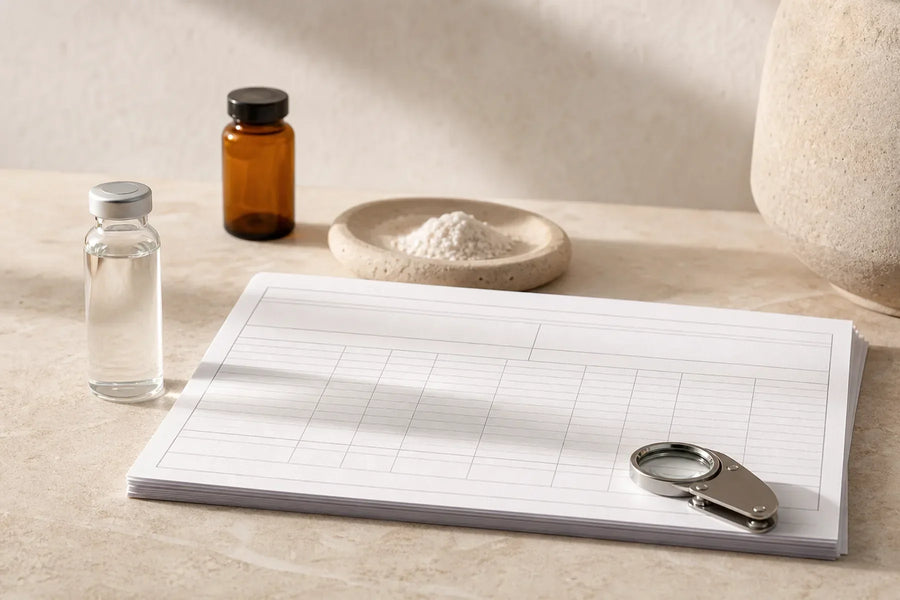
Key takeaways
- A shelf-life statement should be supported by product- and package-specific data.
- Accelerated work predicts risk; real-time testing confirms performance.
- Potency, contaminants, moisture, appearance and packaging can all be stability endpoints.
FDA regulations do not require every dietary supplement to carry an expiration date. When a firm chooses to use an expiration or “best by” statement, however, it should maintain data supporting that the statement is truthful and appropriate for the specific formulation and package. Determining a defensible shelf life is more involved than selecting a standard interval.
The Regulatory Basis for Shelf-Life Claims
Under 21 CFR 111, US dietary supplement manufacturers who choose to place an expiration or "best by" date on their packaging must support that date with actual stability data — placing an arbitrary date on a label without underlying testing is explicitly considered misbranding under federal regulation . This is a critical distinction from many consumers' assumption that expiration dates are conservative, universally standardized safety buffers; in reality, each specific shelf-life claim is supposed to be justified by product-specific testing of that exact formulation, in that exact packaging configuration.
Real-Time vs. Accelerated Stability Testing
Two distinct testing methodologies are used to establish shelf life, each with different tradeoffs between accuracy and speed to market. Real-time stability testing stores product under its actual recommended storage conditions — commonly 25°C and 60% relative humidity — and measures potency, appearance, and other quality parameters at defined intervals across the full intended shelf life, typically 12 to 24 months . This is considered the gold standard because it reflects genuine, unaccelerated degradation under real-world conditions .
Accelerated stability testing stores product under deliberately elevated stress conditions — commonly 40°C and 75% relative humidity — to predict shelf life more quickly, typically within three to six months, using established degradation kinetics models to extrapolate from accelerated conditions to a real-time-equivalent shelf-life estimate . Accelerated testing offers a significant speed advantage for companies needing to establish a defensible shelf-life claim before a full real-time study could complete, but a specific and well-documented risk flagged in industry guidance is relying on accelerated-only data without eventually confirming those extrapolated predictions against actual real-time results, since accelerated conditions do not always model degradation mechanisms with perfect fidelity to real storage conditions .
What Gets Tested, Not Just Whether It "Still Works"
A comprehensive stability study evaluates considerably more than whether the labeled active ingredient dose remains present. Standard testing parameters include potency of key actives at defined time points (commonly baseline, 3, 6, 9, and 12 months, extended further for longer shelf-life claims); microbial parameters including total plate count, yeast and mold, and pathogen screening; physical characteristics including color, odor, appearance, dissolution behavior, and moisture content; packaging integrity, since the specific bottle, sachet, or stick-pack format used can itself meaningfully affect product stability; and contaminant-related concerns including rancidity specifically for oil-based products . This breadth matters because a product can remain within potency specification while simultaneously developing an unacceptable rancidity profile, microbial growth, or physical appearance change — any of which independently justifies a shorter shelf life than potency data alone would suggest.
Bracketing and Matrixing: Managing Testing Costs Across Product Lines
For brands managing many SKUs, testing every individual product configuration through a full stability study is often cost-prohibitive. Industry guidance describes bracketing and matrixing approaches specifically designed to reduce this testing burden by strategically testing a representative subset of product variations — for example, testing the highest and lowest strength within a product line (bracketing) or testing a systematically reduced combination of time points and batches across multiple similar products (matrixing) rather than testing every single strength, flavor, or packaging variant independently . These approaches require documented scientific justification for why the tested subset is representative of the untested variations, and this justification itself becomes part of the stability documentation a brand should retain.
Formulation-Specific Stability Risks
Different dosage forms carry meaningfully different stability risk profiles, and testing protocols should be tailored accordingly rather than applying a single generic protocol across capsules, powders, gummies, and liquids . Oil-based products, including fish oil and black seed oil formulations, face oxidative rancidity as a primary degradation pathway, distinct from the potency-loss degradation pathways more relevant to water-soluble vitamins. Gummies, which involve moisture-retentive matrices, face distinct stability challenges around moisture migration, texture change, and potential microbial growth risk that capsule or tablet formats do not share to the same degree. Liquid formulations introduce their own distinct stability considerations around preservative efficacy over time and potential precipitation or separation of formulation components.
Why Unsupported Shelf-Life Claims Are a Real Business Risk, Not Just a Compliance Technicality
Beyond the direct regulatory misbranding risk, an unsupported or overly optimistic shelf-life claim carries meaningful downstream business risk: a product that degrades in potency, develops off-flavors, or fails microbial specifications before its labeled expiration date creates consumer complaints, potential safety concerns, and reputational damage that considerably exceeds the cost of proper stability testing conducted upfront. Conversely, an unnecessarily conservative shelf-life claim — set shorter than the product would actually support — creates avoidable inventory waste, increased return rates, and reduced margin, particularly relevant for a brand managing inventory and purchase order timing across a broader supply chain, where shelf-life assumptions directly affect how much safety buffer is built into production and reorder scheduling.
A Practical Stability Testing Framework
| Testing type | Timeline to results | Best used for |
|---|---|---|
| Real-time | 12–24 months (full duration) | Gold-standard confirmation of actual shelf-life claim |
| Accelerated | 3–6 months | Faster initial estimate; should be confirmed with real-time data over time |
| Bracketing | Varies | Reducing testing burden across multiple strengths within one product line |
| Matrixing | Varies | Reducing testing burden across multiple similar SKUs |
Integrating Stability Data Into Product Launch Timelines
For a brand planning a new product launch, stability testing timelines should be built into the product development schedule from the outset rather than treated as a final pre-launch checkbox. A common and reasonable practice is to launch initially using an accelerated-testing-supported shelf-life claim while real-time testing continues in parallel, with the plan to revise the labeled shelf life if real-time data diverges meaningfully from the accelerated prediction — but this approach requires the accelerated data to be genuinely robust and the real-time confirmation study to actually be completed and reviewed, not simply initiated and forgotten once the accelerated-based label is already in market .
Interpreting Stability Data When Sourcing From a Third-Party Manufacturer
For a brand that does not operate its own manufacturing and instead relies on a contract manufacturer's existing formulation and stability data, it is important to confirm that the underlying stability study was actually conducted on the exact formulation, packaging, and storage conditions your specific product will use — not a similar but distinct formulation from the same manufacturer's broader catalog. Manufacturers sometimes generalize stability claims across a family of similar products, which may be reasonably justified through bracketing or matrixing but should be explicitly disclosed as such, rather than presented as if every individual SKU underwent its own dedicated testing. Requesting the actual underlying stability study documentation, not just a summary shelf-life claim, is a reasonable request when evaluating or auditing a contract manufacturer relationship.
Packaging's Underappreciated Role in Shelf-Life Outcomes
Packaging format is not a downstream afterthought to stability — it is often a primary variable in the stability outcome itself. The same formulation can have meaningfully different real-world shelf lives depending on whether it is packaged in a high-barrier amber glass bottle with a desiccant, a standard HDPE plastic bottle, or a foil blister pack, given differences in oxygen permeability, moisture ingress, and light exposure across these formats. Brands making packaging changes — even seemingly minor ones, such as switching bottle suppliers or moving from bottles to single-serve sachets — should treat this as a trigger for re-evaluating whether existing stability data still applies, since a packaging change can invalidate a previously established and tested shelf-life claim without any change to the underlying formulation itself.