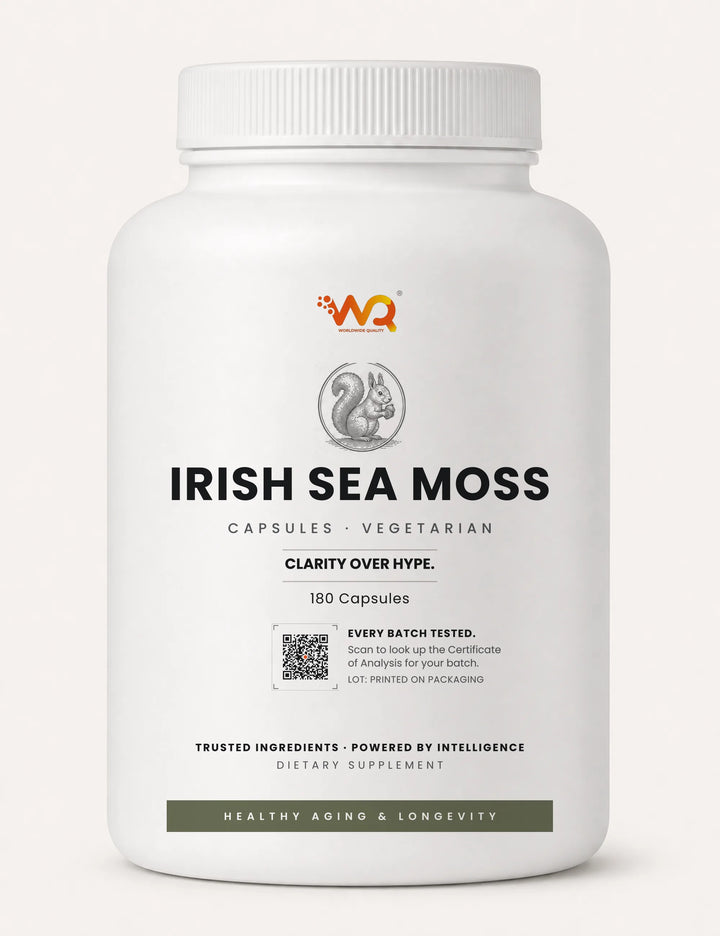
Sea moss has become one of the fastest-growing search terms in the natural health supplement space, propelled largely by social media wellness content. The clinical evidence behind its most common marketing claims, however, is considerably thinner than its viral popularity suggests, and its iodine content carries a documented safety risk that responsible content and product marketing needs to address directly.
What Sea Moss Actually Is
Sea moss, also known as Irish moss, is the common name for Chondrus crispus, a species of red algae native to the Atlantic coastline, related to but distinct from other seaweeds sold under similar branding . It has a mild, somewhat fishy taste, which is why most consumer preparations — smoothies, gels, gummies — pair it with other strongly flavored ingredients to mask it. Its recent popularity is a relatively new commercial phenomenon; historically, sea moss was used more narrowly, primarily for its carrageenan content, a polysaccharide extracted for use as a food thickener in products like ice cream and other processed dairy items .
The Evidence Gap Behind the Marketing Claims
Physicians and researchers reviewing the current literature have been consistent and direct about the state of the evidence. An integrative medicine physician at Northwestern Medicine, quoted in a 2026 evidence review, stated plainly that "high-quality evidence that supports health benefits and claims about sea moss is limited," specifically noting that most of the popular claims around gut health, immunity, and heart health are drawn from broader seaweed research rather than studies conducted on sea moss itself . An independent evidence database reviewing sea moss reached a similarly blunt conclusion, describing it as "a trendy red seaweed sold with sweeping wellness promises" with claims that have "essentially no human evidence" behind them .
This distinction — general seaweed research being repurposed to support sea moss-specific marketing claims — is one of the more common and most easily corrected accuracy issues in this product category, and it is a meaningful opportunity for any brand willing to market sea moss honestly rather than inflating its evidentiary support.
What Sea Moss Does Reliably Contain
Sea moss is a legitimate source of several nutrients regardless of the unproven claims surrounding it: calcium, magnesium, potassium, iron, and zinc are all present, along with a meaningful fiber content that functions as a prebiotic supporting gut bacteria, although the specific benefit magnitude from sea moss's fiber content specifically has not been well isolated in dedicated research . Its most notable and best-documented nutritional characteristic by far is its iodine content.
The Iodine Issue: A Genuine Safety Consideration
Sea moss iodine content is both its most defensible nutritional claim and its most significant safety concern. A peer-reviewed risk assessment study measuring iodine levels in commercially available red seaweeds found Irish moss had the highest average iodine content among the species tested, at 3.86 ± 1.49 mg per kilogram dry weight . The same study calculated that just four grams of dehydrated Irish moss per day contributes roughly 25.7% of the recommended daily iodine intake for children, and that consuming 286 grams per day of Irish moss would exceed the adult tolerable upper limit of 1,100 micrograms set for iodine intake .
This is not a hypothetical risk. A published case report documented a patient with underlying Grave's disease who developed Jod-Basedow phenomenon — thyrotoxicosis triggered by excess iodine intake — specifically attributed to sea moss supplementation, with lab work showing suppressed TSH and elevated free T4 that resolved after discontinuing the supplement . The FDA's recommended daily iodine intake is 150 micrograms, a figure that a modest serving of concentrated sea moss product can meet or exceed depending on preparation and sourcing .
Additional Contaminant Risks
Beyond iodine, sea moss and other seaweeds are known to bioaccumulate heavy metals from the water they grow in, including arsenic, lead, cadmium, and mercury . Because dietary supplements, including sea moss products, are not subject to FDA pre-market approval in the US, product quality, sourcing, and contaminant testing vary substantially between brands, and consumers have limited ability to verify actual iodine or heavy metal content from label information alone .
Populations That Should Avoid Sea Moss
The clinical literature is specific and consistent on this point: pregnant and breastfeeding individuals should generally avoid sea moss supplementation given the unpredictable iodine content and potential contaminant exposure, with published guidance noting that maternal consumption of excess iodine from seaweed sources has caused thyroid suppression in breastfed infants . The same NIH-published database entry states there is no proven medicinal value for sea moss and explicitly recommends avoidance during breastfeeding unless iodine and heavy metal levels have been independently verified as low . Individuals with existing thyroid conditions, those on thyroid medication, and children are similarly flagged as populations requiring particular caution .
What Responsible Sea Moss Marketing Should Look Like
Given this evidence landscape, a nutraceutical brand selling sea moss products has a genuine differentiation opportunity in leading with transparency rather than superfood hyperbole. This means avoiding unqualified claims about immunity, gut health, or thyroid support that are not supported by direct sea moss research, clearly disclosing iodine content per serving with batch-specific testing data, and including explicit safety guidance for pregnant, breastfeeding, and thyroid-condition consumers . A physician's specific recommendation in the available literature — that sea moss, if used at all, is best consumed in small amounts (1 to 3 grams of dried product) incorporated into food rather than taken as concentrated high-dose capsules or gels — is directly usable, source-backed guidance for product labeling and content .
Bottom Line
Sea moss sits at one of the widest gaps between marketing narrative and clinical evidence currently present in the mainstream supplement market: the underlying nutrient content, particularly iodine, is real and measurable, but the sweeping wellness claims driving its popularity are not supported by dedicated research, and the iodine content itself represents a documented safety concern rather than a purely beneficial nutrient . Brands willing to market it with this level of honesty are better positioned for long-term regulatory and reputational durability than those replicating the unsubstantiated all-purpose wellness framing dominant on social media.
Sea Moss and Carrageenan: A Related but Distinct Controversy
Sea moss's food-industry use is tied primarily to carrageenan, a fiber-based thickening compound extracted from red seaweed and widely used in dairy products, plant-based milk alternatives, and processed foods . Food-grade carrageenan is FDA-approved and generally recognized as safe, but its safety profile has been debated in nutrition science circles, with some evidence linking certain forms of carrageenan to gastrointestinal irritation, particularly in individuals with pre-existing conditions like irritable bowel syndrome or inflammatory bowel disease . This is a separate issue from whole sea moss supplementation but is frequently conflated with it in consumer discussions, and content addressing sea moss should distinguish clearly between carrageenan-specific research and whole-food sea moss supplementation, since the two have different safety profiles and different regulatory contexts.
How Sea Moss Compares to Other Trending Superfoods
Positioned against other high-search-volume trending ingredients like ashwagandha or black seed oil, sea moss stands out for having comparatively weaker direct clinical support despite comparable or greater search popularity. Ashwagandha and black seed oil, by contrast, have accumulated meaningful randomized controlled trial evidence for specific outcomes, even if that evidence is still developing in some areas. This distinction is worth noting explicitly in comparative content, since consumers researching "natural superfoods" may reasonably assume similar evidence quality across trending ingredients when the underlying research bases actually vary considerably.
Practical Guidance for Consumers Considering Sea Moss
For a consumer specifically interested in trying sea moss, the most evidence-aligned approach is moderation and food-based incorporation rather than high-dose supplementation, paired with verification of iodine content from any product purchased, given the well-documented variability and testing gaps across commercial sea moss products . Consumers with any thyroid condition, autoimmune thyroid disease history, pregnancy, or breastfeeding status should consult a physician before use given the specific, published case evidence of thyroid dysfunction linked to sea moss consumption .
Final Perspective
Sea moss illustrates a broader pattern common across trending "superfood" ingredients: viral marketing momentum frequently outpaces the underlying clinical research, and genuine nutrient content (in this case, iodine and trace minerals) gets recharacterized as broad disease-fighting or wellness-optimizing power without direct supporting evidence . A nutraceutical brand's most durable competitive position in this specific ingredient category is accurate, safety-forward education rather than amplification of unproven claims already saturating the market.
The Role of Social Media in Amplifying Unverified Claims
Sea moss's rapid rise in search volume tracks closely with its viral popularity on social media platforms, where testimonial-driven content often outpaces peer-reviewed research by a wide margin. This pattern is not unique to sea moss, but it is worth naming directly for content strategy purposes: search demand driven primarily by social virality rather than clinical evidence creates a specific content opportunity for brands willing to occupy the "evidence check" or "what the research actually says" positioning, which tends to perform well with search engines' increasing emphasis on demonstrated expertise and trustworthiness for health-adjacent content, consistent with search quality guidelines that specifically scrutinize health claims for accuracy and source quality.
Comparing Sea Moss to Standardized Iodine Supplementation
For consumers whose actual interest in sea moss is thyroid or iodine support specifically, it is worth directly addressing that standardized iodine supplements or iodized salt provide a more precisely dosable and more thoroughly regulated way to meet iodine needs than sea moss, whose iodine content varies substantially by species, growing region, and processing method . This is a legitimate comparative point for content addressing consumers specifically motivated by thyroid health concerns, since the variability documented in the red seaweed iodine risk assessment study is a genuine practical limitation compared to standardized alternatives .
Sourcing and Quality Verification Practices
Given the heavy metal bioaccumulation risk documented in seaweed species generally, sourcing practices matter considerably more for sea moss than for many other supplement ingredients. Look for products that disclose third-party testing for heavy metals (arsenic, lead, cadmium, mercury) and iodine content specifically, along with clear sourcing information about harvest location, since coastal waters vary considerably in contamination levels depending on regional industrial activity and water quality . This level of sourcing transparency is currently uncommon in the sea moss market, representing another concrete differentiation opportunity for brands willing to invest in and disclose this testing.
Final Word on Responsible Positioning
Sea moss can reasonably be marketed as a source of iodine, trace minerals, and dietary fiber, framed honestly around what the nutrient content data actually supports, while explicitly avoiding the broader immune, gut health, and thyroid-optimization claims that current research does not substantiate at the level implied by most existing marketing in this category . This balanced, safety-forward approach is both the more compliant and, increasingly, the more commercially durable strategy as consumer skepticism toward unsubstantiated superfood claims continues to grow.