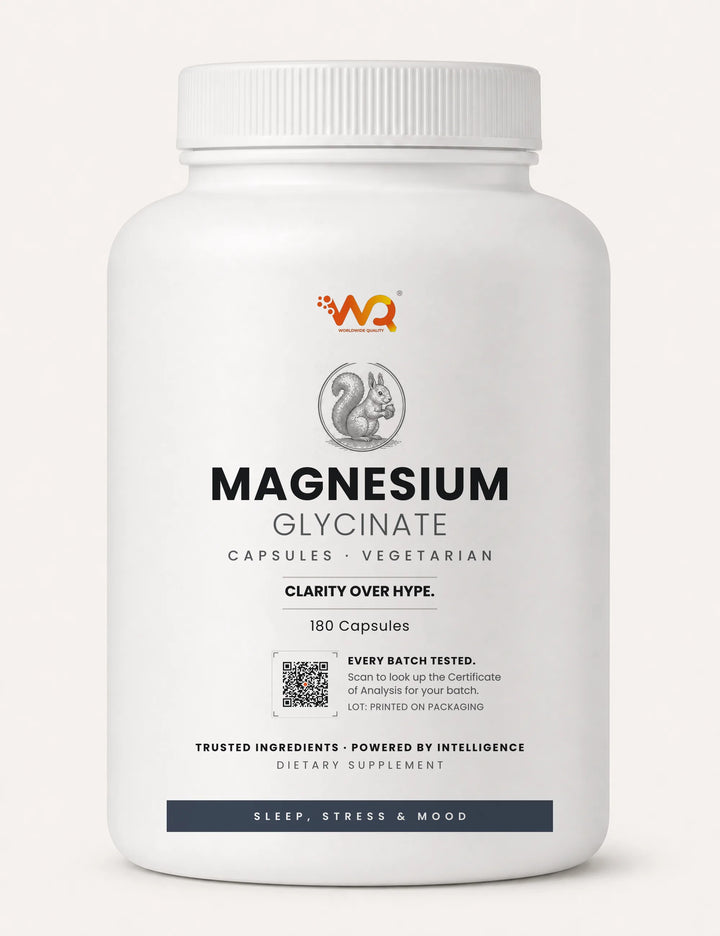
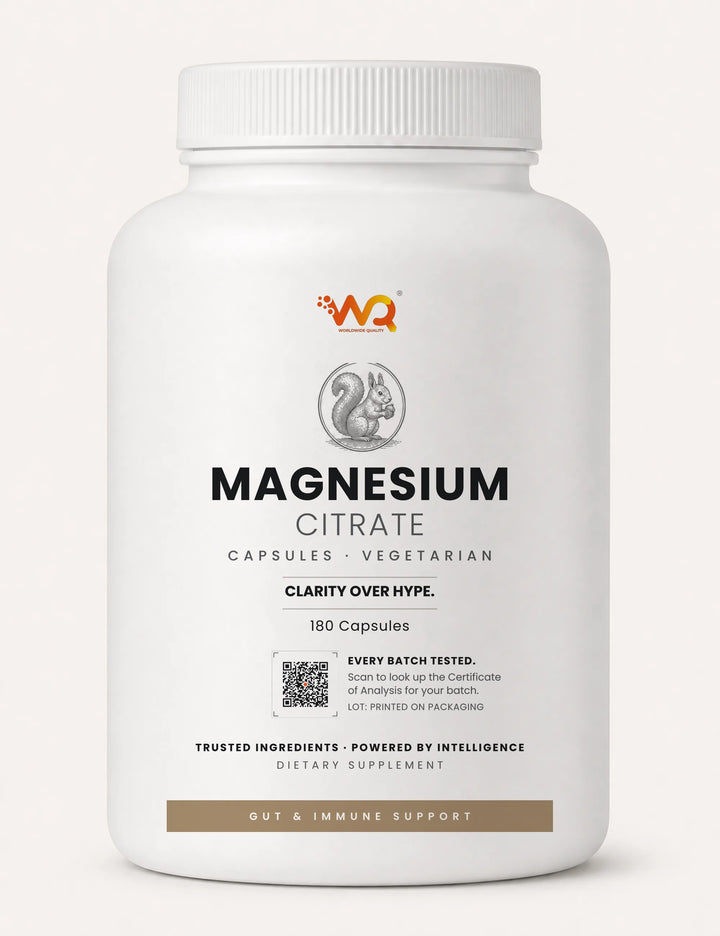
Magnesium glycinate has become the best-selling form of magnesium on Amazon, and for good reason: shoppers who tried magnesium oxide and got an upset stomach are actively searching for something gentler. But "gentler" and "better absorbed" are not automatically the same claim, and the research behind each magnesium salt tells a more nuanced story than most product listings suggest.
Why Form Matters More Than the Word "Magnesium" on the Label
Magnesium is an essential mineral involved in more than 600 enzymatic reactions, including ATP production, protein synthesis, and neuromuscular signaling (ScienceDirect systematic review, 2021). Every commercial magnesium supplement combines the elemental mineral with a carrier compound — oxide, citrate, glycinate, malate, taurate, or several others — and that carrier determines how much magnesium actually reaches the bloodstream, not just how much is printed on the label.
The 2021 systematic review published in Clinical Nutrition ESPEN pooled 14 qualifying bioavailability studies out of 433 initially screened and reached a consistent conclusion: organic magnesium compounds (citrate, glycinate, taurate, malate) are absorbed more efficiently than inorganic compounds (oxide, hydroxide, sulfate), and absorption efficiency decreases as dose size increases regardless of form . That second point matters for label comparisons — a 500 mg dose of any magnesium salt will show a lower percentage absorption than a 100 mg dose of the same salt.
The Landmark Glycinate vs. Oxide Trial
The most frequently cited head-to-head comparison is a 1994 double-blind, randomized crossover trial published in the Journal of Parenteral and Enteral Nutrition, using radiolabeled magnesium-26 to track absorption in patients who had undergone ileal resection . Across the full patient group, glycinate and oxide performed similarly (23.5% vs. 22.8% absorption). But in the subgroup with the most severely impaired magnesium absorption — arguably the population that needs supplementation most — glycinate more than doubled oxide's performance (23.5% vs. 11.8%, p < 0.05), and peak absorption occurred 3.2 hours earlier with glycinate .
Crucially, the same trial reported that glycinate was better tolerated by every participant, with fewer gastrointestinal side effects than oxide . This tolerability difference is the mechanism most marketing claims lean on, and it is legitimately supported by the data — but the absorption advantage is most pronounced in people with existing gut dysfunction, not necessarily in healthy adults with normal digestion.
Citrate: The Middle Ground
Magnesium citrate sits between glycinate and oxide on most comparison charts. Some researcher-facing databases describe citrate as more effective and bioavailable than oxide but note the evidence is thinner than typically claimed . A UK pharmacy-editorial review of bioavailability data across six magnesium forms found citrate reliably outperforms oxide but does not clearly outperform glycinate in absorption, while citrate carries a stronger laxative effect at equivalent doses — a property that makes it the preferred form for occasional constipation relief rather than daily repletion .
Oxide's Real Advantage: It Isn't Absorption
It would be a mistake to write off magnesium oxide as simply "the bad one." Its poor absorption is the entire point of its clinical use for constipation: unabsorbed magnesium creates an osmotic gradient in the gut that pulls in water, producing a laxative effect. The 2023 AGA-ACG clinical guidelines for chronic idiopathic constipation explicitly recommend magnesium oxide as first-line therapy, while stating that comparative efficacy data for citrate, glycinate, lactate, and malate in treating constipation specifically "are unknown" because only oxide has randomized controlled trial support for that indication . Oxide is also the cheapest way to deliver a large amount of elemental magnesium per capsule, since it contains roughly 60% elemental magnesium by weight versus roughly 14% for glycinate.
Comparing the Forms Side by Side
| Form | Elemental Mg (approx.) | Relative absorption | Primary use case | GI tolerability |
|---|---|---|---|---|
| Oxide | ~60% | Low (11.8%–22.8% in trial data) | Constipation, low-cost bulk dosing | Cathartic at therapeutic doses |
| Citrate | ~16% | Moderate-high | Occasional constipation, general repletion | Laxative effect at higher doses |
| Glycinate (bisglycinate) | ~14% | High, especially in impaired absorption (23.5%) | Sleep, muscle relaxation, daily repletion without laxative effect | Best tolerated of the three |
| Malate | ~15% | High | Muscle and energy support | Generally well tolerated |
| Taurate | ~8% | High (may be most bioavailable per some reviews) | Cardiovascular and nervous system support | Well tolerated |
What This Means for Formulation and Marketing Claims
For a nutraceutical brand deciding how to position a magnesium SKU, the defensible claim is specific: magnesium glycinate is absorbed more efficiently than magnesium oxide, particularly in people with compromised digestion, and it is associated with fewer gastrointestinal side effects at equivalent elemental doses . The claim that glycinate is universally "the most bioavailable form of magnesium" outruns the current evidence — several reviews note magnesium taurate performs comparably or better on some absorption measures, and the total elemental dose still matters more than the carrier molecule for most healthy adults without diagnosed deficiency .
Brands should also be cautious about implying oxide is simply an inferior, outdated ingredient. Its clinical utility for constipation is well established and guideline-supported, and consumers using magnesium for that specific purpose are better served by oxide, not glycinate . Segmenting product copy by use case — glycinate for sleep and stress support, citrate or oxide for digestive regularity — is both more accurate and more useful to the end customer than a blanket "best absorption" claim.
The Bottom Line for Formulators
The absorption data supports positioning magnesium glycinate as the preferred choice for daily supplementation aimed at sleep, relaxation, or general repletion without laxative side effects, particularly for consumers who have tried oxide and experienced GI discomfort . It does not support claiming glycinate is superior for every use case, and any marketing copy referencing "bioavailability" should specify what it is being compared against and under what conditions, since absorption rates shift meaningfully with dose size, baseline magnesium status, and gut health .
Dosing Considerations Often Left Off Product Labels
Independent of which salt a formulation uses, dosing strategy affects real-world outcomes more than most brands acknowledge in their marketing. Research on magnesium pharmacokinetics indicates that magnesium absorption happens primarily in the small intestine, plateaus around two to two-and-a-half hours after ingestion, and reaches roughly 80% of its total absorbed fraction within six hours . This means splitting a daily dose into two smaller servings — for example, 200 mg in the morning and 200 mg in the evening — tends to produce steadier serum and tissue magnesium levels than a single large dose, because continuous renal excretion means large boluses are partially wasted through urinary loss rather than retained .
This has a direct product-design implication: a single 400 mg capsule marketed as "once daily magnesium" may be less effective per milligram than two 200 mg capsules taken morning and night, even though the total elemental magnesium delivered is identical. Brands that build divided-dosing guidance into their label instructions are aligning with the pharmacokinetic literature rather than optimizing purely for simplicity of use.
Special Populations and Safety Flags
Any credible content strategy around magnesium supplementation needs to address renal function, since magnesium is cleared by the kidneys and people with reduced renal clearance are at meaningfully elevated risk of hypermagnesemia. Clinical guidance flags creatinine clearance below 20 mg/dL as a threshold requiring particular caution with any magnesium formulation, oxide included . Older adults, who are more likely to have both age-related declines in renal function and a higher baseline prevalence of magnesium deficiency, represent a population where the case for organic salts like glycinate is strongest — not because glycinate is inherently superior, but because the malabsorption research specifically found the largest benefit in individuals with the most impaired gut function, a profile that overlaps meaningfully with aging populations .
Drug interactions are another underdiscussed area. Magnesium oxide's antacid properties can interfere with the absorption of other oral medications, and clinical guidance recommends separating magnesium oxide dosing from other prescriptions by at least two hours . This detail rarely appears on consumer-facing labels but is directly relevant to any brand targeting the 50-plus demographic, who are statistically more likely to be on concurrent medications.
Where the Marketing Gets Ahead of the Science
A pattern worth flagging for any brand building SEO content in this category: many magnesium comparison articles online cite the 1994 ileal-resection study as proof that glycinate is broadly superior, without noting that the study population had surgically compromised intestines — a very different physiology from a healthy adult with normal digestion . Reproducing that framing without the caveat is technically using a real citation to support an overstated claim, which is precisely the kind of soft misinformation that erodes long-term trust with an increasingly research-literate supplement-buying audience. Content that explicitly notes the study population and lets readers judge relevance to their own situation performs better on trust signals and is less likely to draw regulatory scrutiny under FTC substantiation standards for health claims.
Practical Takeaways for Consumers and Brands
For the individual consumer choosing between products, the decision tree is fairly simple: if the goal is sleep support, muscle relaxation, or daily repletion without a laxative side effect, glycinate or another organic salt is the better-supported choice. If the goal is occasional constipation relief, oxide or citrate at higher doses is the appropriate, evidence-backed option, and reaching for glycinate specifically for this purpose is not supported by comparative trial data . For brands, the more defensible and more differentiating content strategy is not claiming any single form is universally "best," but educating the customer on which form matches which use case — a framing that is both more accurate to the underlying research and more likely to build durable trust with a health-literate buyer base researching ingredients before purchase.